Sunday, June 15, 2008
Grading and Nostalgia
A nice little walk down memory lane, especially in the light of the 2008 A Beginner's grading.
On Thursday, this year's batch of beginners (who are a highly impressive group, I must add) did their hakama and 10th kyu grading. Since I'm usually there to help out, I came as well to give any last minute tips or assistance. I ended up being on the judging panel to replace Robin-senpai, who left his reading glasses somewhere. I sat alongside Clem, Awa, Henry-senpai, and Richard-senpai (who was our chief judge)
For the first time, I'd be sitting in front of my kohai and observing them. Not a position I'm most comfortable in, I admit, given that I'm either usually a standing little bit to the side or observing from behind, sneaking up on people to give them pointers :D. Also, I'd have to write down constructive comments for most of them, again something I haven't done much of. Hahaha.
It was a bit surreal sitting there, watching the beginners perform and writing down comments that would hopefully be useful for them. I mean, it wasn't that long ago when I did my hakama grading, along with Clem and Awa. Sensei, Jeffrey-senpai, and Terry-senpai sat in front of us, watching our moves. I could picture myself as one of them, tense, nervous, and more than a little bit stiff. Their footwork, their swings, their kiai really brought me back to that first grading.
The beginners performed quite well given the length of their training, at least better than what I remember from my own experience. Some were real good, some could use a little bit more training or confidence, but everyone impressed the heck out of me. Seriously. Kudos to them.
The grading itself went pretty smoothly, don't recall any delays. Starting with kamae, they went into footwork, the basic suburi, and jumping suburi, before finishing off with the first two bokuto keiko and a short written exam. It's a pity that we were on a pretty tight time constraint, as a little comment session would have been good, while the memory of their grading was still fresh.
In the end, all 14 of the attendees (there was supposed to be 17, but three didn't show up) passed the grading, and will hopefully continue learn with the rest of us now that they've earned the right to wear hakama. Well, I certainly hope so. Sparring with some of them will definitely be exciting.
Also, looks like I won't be going to the Winter Camp this year. Oh well.
Cheers, all.
Thursday, February 7, 2008
Reflections on the 2008 Beginner's Cup
Well, I have a good reason for not putting the previous two sessions. Actually, several good reasons. Mainly study (no, I’m serious!), but also because my mind had been preoccupied with the Beginner’s Cup (and the fact that I didn’t record Saturday’s session “-_- ). And now that that’s over with, I can concentrate a bit more on writing.
I’m not going to go into too many technical details – this is going to be mainly a reflection.
It began with warm-up. Or, for those who came a little earlier, mopping the floors (we finally found where they stash the cleaning supplies...mwahahah). Short briefing, during which Sam-sensei taught us about the way real shiai competitors warmed up.
- Do it together, with team captain leading
- Do it full of vigour, so that you’re actually tired but not exhausted.
- The warm-up should be hard enough that your heart reaches up to around 180-200 beats per minutes. Alternatively, you should feel pretty worn-down by that time. I doubt anyone’s really going to care exactly how many beats per minute your heart is...er, beating, unless it’s the medic.
- Do it wisely – conserve just enough energy for the upcoming battles.
- Kirikaeshi (2x)
- Big men, 3 each (2x)
- Big kote-men, 3 each (2x)
- Ai-men, 3 sets (2x)
A little nerve-wracking, I have to say. Of the nine, only six would move up. Of the six, only four. Of the four, only two. And from the two, to quote those Highlander films, “there can only be one”. If this was a simulation of life-and-death clashes, eight of us would be dead outright, only one person surviving (and possibly just surviving).
So we drew straws. And here are the results
Group 1 – Kevin – Dabao – Clark
Group 2 – Clement – Omar – Awatea
Group 3 – Ann – Amy – Annie
Just my luck. The two people I’ve always been preparing myself for the inevitable crash – my kendo siblings Clem and Awa. It’s quite ironic; the three of us always imagined we’d be pit against each other sooner or later. Now we had the chance to play that out. In our very first shiai, no less. Despite feeling a little anxious, knowing the guys were already dangerous in keiko, I felt quite happy with this coincidence. We would be able to show each other our outmost respect through fighting with all we’ve got, test our strengths and weaknesses, and simply see which one of us will have the drive to go all the way. Plus, we already said we'd fight each other one way or another, so it's already good.
To cut the story short, I wasn’t the one who had the drive. Well, maybe I did, but not as much as Clem or Awa. I did, however, give them both everything I had. For the first time since the jigeiko with that inhumanely fast Japanese sensei during the Winter Camp (see that previous entry), I got that same “it’s a good day to go down fighting” feeling. A few butterflies in the stomach, but the moment we entered the arena, there was no time to feel sick or scared. I promised myself that I wouldn’t hold back. I kept that promise, somehow.
Against Clem, I actually managed to get my first ippon in a shiai. Ever. Funny thing was that I didn’t realise it until I nearly stepped out of bounds. Didn’t even think, just automatically did something and managed to convince the shimpan that I scored a hit. No pride in that immediately after - our scores were tied and I already had a hansoku from stepping out of the arena. About a minute later, I’d lose the match from going one step too far. That’s my big regret. Who knows what the outcome would’ve been had I not hansoku-ed myself out?
Fighting Clem was almost like fighting a mirror image...only one that’s faster and has better reflexes than myself :D I learned from the last few jigeiko that it’s no use to jump around and be too tense (thanks Ruby-senpai and Do-Hun-senpai!), so this is the first time I’ve managed to try to stay calm and maintain my centreline . My timing was a little off, but no worse than usual. The one thing I can clearly remember from this match was that the movements we were both doing now have changed significantly from the ones we did during our shiai at our last session in 2007. We only attacked when we thought we saw openings, and even then we had some vague idea at least of what were aiming to do. That’s also probably why our match didn’t last for long, bar getting penalized for stepping out one too many times. Short, and intense. No nervousness here, come to think of it. Almost too calm, if it weren’t for our kiai every now and then.
Against Awa...well, that’s a completely different. No ippon at all – I think we had the shortest match in the whole tournament. Haha. Two shomen-ari before the first round was even up. One before the first ten seconds were up, actually, if my perception of time isn’t distorted. What surprised me the most, however, was how quickly he could get me. Not just his attack speed, but also the way he could move into his issoku-itto-no-maai without me noticing. All of a sudden I see him lift for an attack, and by then it’s too late for me to counter. Just attack after attack after attack from him. And when I finally attacked, I realised that I projected my attack too early.
Also, I felt a different kind of atmosphere from Awa as we fought. It wasn’t intimidating, but solid. I don’t think I was so much afraid; it was more like being blocked by a brick wall. For that short time, I could see some openings, but was always a second too late before he covered it and went forth. In the end, I simply couldn’t beat him. I don’t recall ever facing that in jigeiko. I mean, I can’t really beat in jigeiko yet either, but this was a completely different feeling. Perhaps that was the psychological manifestation of his will to win? How very anime...my mind blanketed by his overwhelming ki.
What I noticed afterwards from Awa surprised me even more. From the beginning till the end, all his ippon were men cuts. Just simple, small men cuts. Whereas Clem and I (or maybe just myself) tried out kote and men cuts, Awa seemed to focus on making his men cuts more accurate and well-timed. Perhaps that says something about training...is it better to use the one move you know you’re good at all the time, or try to surprise the opponent by using the entire arsenal?
It couldn’t be any more ironic that Clem and Awa would face each other first thing in the quarter-finals. The look on Clem’s face was priceless when he found out, and we had a good laugh. It was as if the three of us are destined to be always facing one another during our kendo lives. And it was an impressive match. Neither of them would back down, but only one would move on. They really went all out for this one, both relentlessly attacking and countering. A truly intense battle. It took almost the whole two rounds before Awa got the winning score – a clean shomen-ari. I had a hunch early on that Awa would be the one who’d win, but the way they both fought made it clear that anything could happen. Clem also had a good chance of winning – he also made many good hits with good timing. It was mostly due to his incomplete zanshin that he didn’t score as well; still, he could have won, if Awa made a mistake somewhere. It’s a pity that they had to fight so early, as it would’ve made a great final match. Epic, in beginner terms. Heheh. I wasn't surprised that Awa would win the whole tournament, and Clem awarded both Smartest Fighter and Most Promising Fighter, the latter award along with Kevin and Ann. Epic, I tell you.
In retrospect, I had gained so much from something that I had almost nothing to lose from. I gained a better understanding of how a shiai works, and how it feels to be in one, if only among my kendo family. I learned more about my 2007 beginner friends through challenging and observing them. I understood a bit more about my own fears and will to win. I was able to show my best friends that I too would take them seriously, even if I couldn’t win against them. And what had I to lose, except the money I paid to register and a good bit of my ego?
There had been a moment, right after my second and final defeat, that I suddenly felt numb. For the first time, possibly in my life, I lost even after trying my best. And I really mean my best – I had no intentions to lose against Awa or Clem, and really wanted to give them a real fight. As I went into seiza and took of my men, I stared into it for a moment. I felt a little sad, with a twinge of regret. Why didn’t I win? Why didn’t I move faster? I certainly didn’t expect to be put out of the fight so soon, yet I’m holding my men in my hands, knowing that I won’t be putting it back on for the rest of the evening. But the shock of defeat was soon washed away, replaced by a content acceptance. I wouldn’t have wanted it any other way. I fought the two people I’ve always seen myself fighting, even got a good hit in once. Better yet, one of them had the chance to go all the way to the finals. I could make up for this defeat next time, even it may take years. In the end, those were both matches I walk away from without any regrets. Well, except for the regret that I won’t be able to join a Beginner’s Cup anymore. To regret and despair now would only hold me back from going up that next stage. Next time, boys, next tournament I’ll try even harder to meet you somewhere further up than just the preliminaries. And perhaps next time, I’ll be a little wiser and be able to give you both a better challenge. Yar.
Overall, everyone did very well, even if there was only one winner/survivor at the end of the day. We all fought to the best of our abilities, some of us to the brink of complete exhaustion. I was surprised at how fiercely Ann, Amy, and Annie fought...looked far more brutal than any of the guys :D Though some matches seemed to favour one fighter, the one who was perceived to be at a disadvantage would still give a serious effort to win. Like Amy going against Awa, but still fighting her hardest. Several senpai commented how our fighting spirit was impressively high for our level, and Sensei was pleased by our performance. That’s already something we can take with pride, regardless of outcome.
From now on, it’s only logical to fight even harder. We’re no longer beginners – the Cup was our rite-of-passing into a wider world of kendo. From here onwards, though we’re still beginners in terms of kendo experience, we’re a bit wiser and more mature than when we first started. Soon we’ll have to look beyond our own club and start meeting our peers from other clubs who will challenge us, sometimes winning and sometimes losing. The first hill has been climbed – the next mountain in a long range of mountains is waiting over just over the plateau.
We have all won, in our own ways. And maybe by losing enough, we’ll start winning more. Until then, though, it's time to train. I'll have the session review as well as the missing session up, hopefully before Monday next week.
Fighto!
------------------
Update: After watching our shiai DVD, I realized a few things. First, I need to be more aggressive. A lot more aggressive. Second, I need to train my eyes and senses so that I'm not solely dependent on sight to measure maai (which is extremely dangerous if I'm not fully aware). Third, I need to master the basics. Awa got through solely on his men cuts - perhaps if I focused more on that the rest would start to flow naturally. Fourth, I need to 'let go' of myself like Awa did...focusing to the battle ahead and be reasonably detached from everything else. Now that I think about it, it was a bit unnerving to face someone who was composed. Lastly, I need to learn how to look less comical when I hansoku myself out. That was rather...silly, to say the least. Haha.
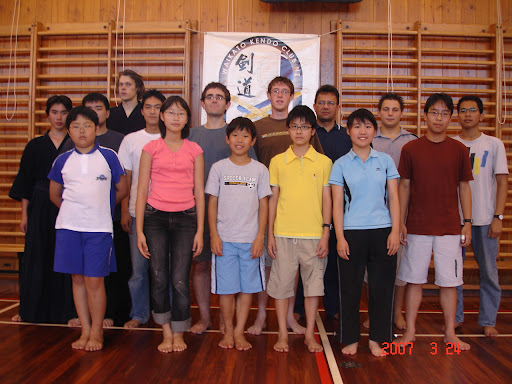
Monday, January 28, 2008
Training Session on Saturday, 26 January 2008 - First Grading 2008
Training Schedule on Saturday, 26 January 2008 - Grading
- No warm-up
- Grading
- 2 groups
- Below 6th kyu
- Ashi (Footwork)
- Forward and backward, 2 steps each until stopped
- Left and right, 2 steps each until stopped
- Suburi
- Jogeburi
- Men
- Kote
- Do
- Suburi with motodachi
- Big men, 8x
- Big kote, 8x
- Big kote-men, 8x
- 6th to 3rd kyu
- Bogu keiko - in pairs
- Big men cuts, 4x
- Big kote cuts, 4x
- Big do cuts, 4x
- Big kote-men, 4x
- Big kote-do, 4x
- Go-hon waza - only for 4th and 3rd kyu
- continuous: men - kote - do - kote-men - kote-do
- Kata
- 6th - 5th kyu: ipponme and nihonme kendo kata
- 4th - 3rd kyu: ipponme, nihonmen, and sanbonme kendo kata
- Jigeiko session
- from 5 to 6 pm
- Terry-senpai joined up!
- Debriefing
- Grading
- It's like growing up; you have to do it anyway. It means more challenges and responsibilities, as well (I assume it also means we'll be more experienced...).
- Jigeiko
- Always try to reserve some energy for sensei or senpai - don't make them wait (or give them a chance to rest :D)
- Homework
- Write an email to Sam-sensei regarding what we've learned since he left us in 2007.
Ah, and before I forget:
Results
- William: 8th kyu
- Amy, Ann, Annie, Clark, Dabao: 6th kyu
- Awa, Clem, Douglas, Kevin, Min Seong, Omar: 4th kyu
- Andrew, Ari, Darrin, Min Gi: 2nd kyu
On a personal note,
- My wrist is strong enough to do suburi, so hurrah for that.
- Do cuts still a complete mess! Argh. Might also be because I was pretty nervous.
- Note to self: try not to get over-anxious during grading. Forgot to drink before and that kind of messed me up. So don't do it. Mm'kay?
- Train some more on kote cuts. Kept missing distance (and hit my partner on the arm several times - gomen)
Friday, January 25, 2008
Training Session on Tuesday, 22 January 2008 - Au Revoir, Nicolas
Hope that didn't sound too much like an obituary. Ahem.
Well, here's a recap of what happened.
Training Schedule on Tuesday, 22 January 2008
- Briefing
- Grading on Saturday
- Today - Nicolas' club farewell party
- Reviewed important points of Saturday's training.
- No group haya suburi for the next few session, going to focus on other fitness exercises.
- Warm-up
- Normal
- Sensei's tip - the kendoka leading the warm-up should be confident and have the order of exercises memorised. Otherwise everyone else's concentration will be disrupted and the warm-up not as effective.
- Fitness
- Haya suburi
- Focusing on the points from Saturday
- Haya with motodachi - 30x each, 3 sets
- Motodachi should relax grip when partner is raising his/her shinai, and tighten when partner cuts
- 1st set - focus on differentiating speed between raising and cutting
- 2nd set - focus on speed and ten-no-uchi3rd set - focus on both previous points and footwork; also pay attention to eye contact and feeling natural bounce from ten-no-uchi assist in raising shinai.
- Note: from now on, less emphasis on quantity of haya suburi done and focusing more on unity
- i.e. everybody has the same frequency, speed, and movements - doing so will distinguish us from all other clubs.
- Discussion
- On effort
- as a beginner, one should always concentrate fully on kihon. Once basic kihon has been understood and somewhat mastered, the kendoka must then learn how to do it smart. Destroying body and mind through working too hard is counterproductive and should be avoided. However, this does not mean that the kendoka can be lax and lazy when training. Simply put, kendo is for survival. You still have to give it 100% effort but at the same don't kill yourself doing so. Balance.
- On reflexes
- If you see a cut coming your way, it's too late - you're getting hit. In the short time the reflex order is sent from the eyes to the brain, there's still a 'loading' time where you're vulnerable and unable to react quickly.Better to analyze your opponent to anticipate the next move.
- On bowing
- stop bowing directly after finishing a kihon (e.g. slightly bowing when still in kamae after kirikaeshi). This is considered as being disrespectful of your partner, so better to do it once at a safe distance.
- High-speed haya suburi, 20x each, 4 sets.
- looks insane
- don't focus on anything other than doing the fastest haya suburi you can manage (or more)
- Sensei's tip - pull down and cut immediately once you can see your left hand has cleared eye level. Also, don't worry about kamae, footwork, or even proper cutting for this exercise
- Bogu keiko
- Kirikaeshi - 3x
- Big men cuts, 3 each - 3x
- Don't hit before motodachi opens; also, keep in semei a bit longer before striking.
- Big kote-men - 3x
- Big kote-do - 3x
- The do strike should come before the zanshin, don't end up striking completely parallel to the do.- - note: always move from the right foot (?)
- Kakari-keiko - 15 each - 1 set per person
- remember that it always starts and ends with a big men cut.
- focus on:
- proper, correct, accurate, and fast cuts
- finding personal issoku-itto-no-maai
- Shiai keiko
- Nicolas' farewell party - 2 minutes each or 1 ippon.
- Results
- - 8 wins for Team Nicolas
- - 10 wins for Team Waikato (everyone else)
- Notes
- Sam-sensei: kendo is like drama; it's not only about waza but also about spirit and making a good show. "Pretending" may persuade the judges to pick one side over the other, even when all other things are considered equal.
- Saw (or I think I saw) a nuki waza happening in a shiai setting - wow.
Ah, sorry about some of the pictures not coming out quite well...messed up the settings on my camera :S And I should probably get the lenses cleaned up...
p.s. does anyone know whether it's better to link up the photos to another site, e.g. Flickr, compared to directly uploading them to blogger? Just wondering.
Sunday, September 9, 2007
Sayonara, Sensei
[Note: I realise this post has come far too late to be of any consequence. T_T Gommennasai, Sensei *bows*]
[Gah! And I forgot to write about the Saturday session! Gommennasai, everyone *bows again*]
Friday, September 7, 2007
September 2007 Kyu Gradings
------------------------------------------------------------------------------------------------
September 2007 Kyu Grading
Ah, I’m back again with yet another belated post. Trust me, I’ve got the three previous sessions in the draft section, but none of them are really fit for posting (curse my fickle obsession with blog perfection!). I’ll definitely post those up...eventually :S
Anyway, on to the main topic. Last Tuesday, 4 September 2007, the Club held a kyu-rank grading. Read below to see what we did...
Beginner Grading
So the night started off with the recent beginners class doing their (hakama?) grading, with Benjamin, Jeffrey-senpai, and Leo-senpai as the panel. Here’s a recap of what was tested:
Footwork
- Forwards and backwards (2x each until stopped by panel)
- Sideways (2x each until stopped by panel)
- Forwards and backwards at a 45 degree angle to the right (2x each until stopped by panel)
Suburi
- Jogeburi – 20x
- Men cuts – 20x
- Kote cuts – 20x
- Do cuts – 20x
- Jumping suburi – 20x
- Kote-men cuts – Until stopped.
- Kote-do cuts – Until stopped.
Pretty much everyone did well, and I think everyone passed. Kudos to you guys for making it through your first grading!
With that done, we move on to...
Senior Grading
Oh, before I forget, credit for this summary goes to Tatsuaki, who wrote it down for me. Thanks, Tatsu!
Suburi
- Jogeburi – 20x
- Men cuts – 20x
- Kote-men (with ichi-ni backwards footwork) – 20x
- Jumping suburi – 30x
- Waza (in pairs assigned from group)
- Big men strikes with zanshin – 2x each
- Kote strikes with zanshin – 2x each
- Do strikes with zanshin – 2x each
- Kiri-kaeshi -1x each
Kata
- Ippon-me kendo kata
- Nihon-me kendo kata
For some reason, almost everybody was quite tense during this grading, and as a result we didn’t do as well as expected. Afterwards, we had jigeiko for about 15 minutes while the panel disappeared to reach the verdict. Here are the general inputs Marleen-sensei, Sam-sensei, and Jeffrey-senpai (as the panel) gave when they reappeared.
- The most important thing to focus on at the moment as a kyu-grade kendoka is ki-ken-tai-no-ichi. Get that right, and good kendo should follow.
- The motodachi (because the people doing the grading had to do the waza section in pairs) weren’t very good in receiving the cuts. The reasoning is one of the obligations of a senpai is to teach the kohai, and must therefore be able to receive the cuts properly to allow the kohai to understand how to do it right. Also, being a senpai means getting hit a lot more often. And so forth.
- Generally speaking, most of the do cuts were pretty off. Apart from that, Sam-sensei also mentioned that the zanshin would have to be done much faster and with more readiness.
- The kirikaeshi was okay, motodachi need more practice (as in point 2).
- The footwork for the kote waza needed improvement. People were taking large steps, which meant that they had to pull the shinai lower than the navel (because they reach the target before the cut is made). Focus more on small steps and extending the arms.
- Tennauchi needs improvement.
- Good kiai for the most part.
On a more personal basis (oh noes, rambling!), I didn’t do as well as did during training. Despite having reassured myself that it was only a grading (“a grade’s only a number, not a factor” and whatnot), I still managed to get pretty nervous. I think I still used too much right arm power for the suburi, but otherwise it was manageable. By the time we were in bogu, my arms felt like lead. Not good. Extremely sloppy,wooden waza and kirikaeshi (and I still haven’t gotten over that completely :D). Breathing also a mess – must stop using kiai excessively. And tense! Argh. So much to improve...oh well. At least I know where I stand at the moment.
Well, to make a long ramble short, everybody passed. I’m not going to put in the full list of who got what grade, it’s already on the club’s blog. Congratulations all around to us all! Yay!
Righty-o, that should sum up tonight’s business.
By the way, I’ve still got a pile of draft handouts from Marleen-sensei on NZ kendo events from August 2007 to 2008. If you haven’t gotten one of these, ask me on Saturdayso I can give you a copy. M’kay?
------------------------------------------------------------------------------------------------
p.s. Thanks for commenting on my blog, Ruby! Sorry about not getting back...I wanted to post a reply on your blog, but for some reason my laptop won't allow it. Meh. Bad zanshin! Bad follow-through! Ahem. Yes. Thanks all the same, senpai :D
Tuesday, August 14, 2007
Winter Camp
-------------------------------------------------
Waikato Kendo Winter Camp 2007
nearly two full days of kendo. It was amazing. Just being in the same hall and practicing with so many others (far more than the club has, at any rate), listening to the sharp cracks of shinai in unison with the battlecries of more than sixty people. And in the middle of it all, before the banners of the Federation and the club, Inoue-sensei sat serenely, watching the young hopefuls battle others and themselves. At least, that's how I remember it. Please do excuse me if I seem to glorify it a tad much.
On a less dramatized note, the Winter Camp took place last weekend, from 9 am to 5 pm on Saturday and from 8 am to 3 pm on Sunday. Over sixty participants from clubs throughout the country (around 10) joined the Camp, which was hosted by none other than the Waikato Kendo Club. The highlight of the camp was a visit by Inoue-sensei, an 80-year old hachidan from Japan who is today considered to be a 'living treasure' due to his advanced knowledge and understanding of all things kendo. The following post is a reflection on what I personally found to be of importance, both internally and externally, from that weekend.
Mindset
This doesn't exactly fall into the 'camp' category, but I thought it would be pretty useful if I wrote it down for future reference. On the Friday before the camp, the New Zealand national kendo team practiced at the Uni's Rec Center basketball hall from 08.30 to around 16.00. I came in around noon to watch how they trained. After their warm-up session (which seemed tough enough as it was, lasting for more than at least two hours), they began to do jigeiko. At this stage, Inoue-sensei came up to watch over the combatants. After the first few rounds, he stood up and began to talk about having the right mindset when going into battle. Here's what I caught on to:
- Always be prepared, even before battle. If you enter the battlefield without taking note of your opponent and your surroundings, you will already have disadvantaged yourself.
- Start analyzing your opponent and make plans of attack as you step into the arena. Note how they walk, hold their shinai, gaze/stare/look, etc. Do this even when bowing or sonkyo, both starting and finishing.
- Note to self: this may mean I'll need contact lenses if I'm going to keep practicing for at least another year.
- If you go into battle without having a plan of attack, you will be hesitant and as a result your kendo will not be good.
- I'm not quite sure about how he meant it, but the way I interpret it is that if I go into a battle without a clean plan of what to hit and when to hit, I'll attack wildly and I'll hesitate a lot (which does ring true for when I do jigeiko).
- Have a 'battle-face' ready.
- It was something about going into battle with the appropriate facial expression to allow for the mindset to kick in. Inoue-sensei referred to the semi-legendary swordsman Miyamoto Musashi having a battle-face which was somewhere between a deep frown and a thoughtful expression. So, frowning deep enough to create a small furrow above the bridge of your nose, by completely focusing on the opponent. Actually, I might have this the other way around, as, logically, if you focused your eyes on the opponent intensely, you'd eventually go into a semi-frown. Might have to check with Sam-sensei or Marleen-sensei for a better explanation.
- Always have it in your mind that the encounter will be a life-or-death situation.
- How exactly we're supposed to achieve that feeling is still beyond me, but I think it's something you get after enough fights. Hopefully.
During the camp, I also got some more personal lessons on mindset. Here are the ones that gave me a lasting impression.
- Commitment.
- It wasn't really a specific lesson that we were all taught, but more of something that I pondered on throughout the length of the entire camp. I remember that it was after a tough suburi session on the first day (see the kiai section for more of that) that Bennet-sensei of the Christchurch dojo (who was supervising the drill) called us together and began to talk about commitment. Whoever didn't want to take it anymore was welcome to pack up and go home. I have to admit, I felt a little shaken at that point. The choice was either to stick it through, pain and all, or go home, in front of at least 50 other kendoka, and not be able to show my face for quite a while. Unless, of course, I had an asthma attack or something, which would validate my reason for leaving. So I stayed, although maybe for the wrong reason. As the days went by (as well as a particularly long night), I had more chances to think about where my commitments lie. Lots of doubts, especially during tough keiko sessions. I still haven't come to a conclusion yet, but I got this in my mind; kendo isn't all about fun and games. It can be fun, but it requires patience, perseverance, and a willingness to get throughly exhausted.
- No regrets.
- This is probably the one experience I can still recall properly throughout the whole session. I was standing in line during a jigeiko session with the sensei on the Sunday afternoon. There were five people waiting before me, so I had a good chance to look at how the sensei I would face (Ken-sensei, from Japan) fought. That's when an image popped in my mind. It was like one of those epic war movies, where you have the champion of one side cutting the ranks of nameless footsoldiers with barely any effort. As I got closer, I realised that there was no way that I'd be able to defeat him. Knowing that, I began to relax slightly. I put it in my mind that even if I couldn't 'kill' him, I'd die doing the best I could in trying to do so. So when my turn came up, I felt virtually nothing. I was breathing a lot better than when I usually do jigeiko, and I was able to complete most of my strikes properly. He gave me a sound beating (five men and kote strikes before I can even lift my shinai, and that was in the beginning!), as expected, but I left the jigeiko feeling happy and satisfied with how I performed. I was well and truly spent, but it felt like I honestly accomplished something meaningful (rather than make a half-hearted attempt and lie to myself that I did something). I don't think I can thank him enough for opening my eyes to that feeling; I'm hoping to one day be able to use it on a regular basis.
- Self-confidence.
- It felt a little intimidating to be in the company of so many other kendoka, most of them better than myself. Especially when we trained in pairs. I think I annoyed some people for doing a poor job being motodachi. Or the time I accidentally whacked a certain someone over the head with my bokken during nihon kendo kata, which was a rather distressing event (but useful, as it taught me not to let my kensen drop when swinging). Eventually it occurred to me that rather than try to catch up with the levels of all the others, which would be futile, I might as well do the best I can at my level.Heck, even at one stage Inoue-sensei must have been a beginner too. Better to work longer on a steady base than go up high only fall back down because of weak foundations (eh?).
Probably the aspect of kendo that Inoue-sensei emphasized the most. All through the weekend, he talked about how important kiai was in kendo. It wasn't only the breath and the voice, it was the measure of the soul and how much you were willing to give in the fight.
- Keep kiai loud and clear, and don't stop it on a lower note.
- Best example: one-breath suburi. The first real (i.e. non-kata) training we did on the Saturday was constant empty cuts, with various styles of cutting (see techniques section for explanation). The difference was that we would do it in pairs, and compete to see who could last longer on a single breath while constantly using kiai. We weren't allowed to let our kiai drop, and had to know our limit. Now that I've tried it out in a jigeiko setting, it makes a little more sense too this newbie mind. If I drop my kiai after a single strike, I relax slightly and think that I have some space to gather myself for a next attack. I'll probably miss the strike and get hit (several times, actually) before being able to go for another, not to mention having to wind myself up for another attack (which would take time and extra energy). On the other hand, if I keep my kiai, I'm forcing myself to stay conscious and therefore a bit more able to rebound with another attack. Still, it's no use if I keep screaming and run out of breath halfway through...
- Kiai for the benefit of others.
- This lesson came from Bennet-sensei. He talked about the importance of kiai not only for those in combat, but also for those watching. Everyone in the dojo is training, whether directly or indirectly. Those not training or waiting for a turn have the responsibility of cheering on the people they are watching. This support is meant to help the fighting spirit of the trainee up so that he/she is continually encouraged to push the limit and concentrate on perfecting his/her kendo. Or, at least that's what I think Bennet-sensei was talking about. Whatever the goal, it's good to maintain solidarity among fellow kendoka, especially those of the same club. Fighto!
Funnily enough, this is the one section that I didn't make too many notes on. So here's a short list of new training sets we went through...
- One-breath suburi.
- As mentioned before, doing suburi for an amount of swings with only one breath (which means one continual breath, no pauses inbetween). Enforces concentration on breath control and arm movements. Two main variations:
- x [insert suburi type] forwards, y backwards (e.g. 4 jogeburi forwards, 5 back)
- [insert suburi type] until your breath runs out. Can have further variation such as:
- Jumping suburi
- Jumping suburi with one swing per step (instead of back - forward/strike - back, back/strike -forward/strike - back/strike)
- 'Switchfoot' suburi (position of kamae switches every strike via a hop, but still in kamae)
- Note: If my terms are a bit (yeah, right) confusing, try them out. Might work better that way.
- One breath kirikaeshi.
- I think some of the others have already pointed out this one. Normal kirikaeshi, but on one breath from tai-atari.
- A variant of this was doing it in rounds, where the motodachi begins kirikaeshi once the person doing it first runs out of breath. The first person thus becomes motodachi, and does the same routine. This can go on for several rounds until both are completely exhausted. To help both motodachi (as both become motodachi in cycles) react better once the partner runs out of breath, two additional people can help on either side, pushing the motodachi forwards to keep the cycle going.
- One breath continuous stamping strikes.
- Similar to the stamping strike (fumikomi-ashi?) exercise we do, which is doing a number (or an unlimited number) of strikes with stamping from one end of the gym to the other. Only difference is that all the strikes from one end are in one breath. Watching the more experienced senpai do it was particularly exciting; one looked almost as if he were running half an inch off the ground, but his stamps still came at the same time as his kiai and tennauchi.He also got a recognition from Inoue-sensei.
- I found out something I didn't realise about my fumikomi from Wells-sensei. He told me that my swings were too fast for my feet, thus I finish my strikes off before the stamp. Currently trying to remedy that.
- The 'Devil's Own' Keiko.
- Not sure about the real name for this, 'Devil' keiko is just what I termed it. It was given by Bennet-sensei, and lives up to its name. It goes like this:
- Start off with jigeiko,
- Continue into five sets of men-kote strikes,
- Go straight into kakari-keiko,
- Finish off with a round of kirikaeshi,
- Rinse and repeat the above steps until a) the instructor signals stop or b) you drop from sheer exhaustion.
- I kid you not, it can get tough. It probably only goes on for five to ten minutes at the most, but it'll feel like an eternity when you're doing it. Highly recommended to strengthen stamina and willpower, as you might well be wishing to faint after the first few rounds. Fun for the whole kendoka family. Nonetheless, it really made me realise how important it is to relax my shoulders, control my breathing and be especially attentive as a motodachi.
And now, for something completely different. As most of us will probably know, Inoue-sensei is renowned for his philosophical insight on the meaning of kendo kata, and has published a book on the matter. Therefore, it we were extremely fortunate to be able to learn this from the man himself, without having to buy the book. Although buying the book would've been technically cheaper, it would never have amounted to the value of being able to see Inoue-sensei show us precisely what he means. In short, it made all the difference in performing the first three kata. The gist of it was that kata 1 to 3 are not simple simulated encounters between 'good' and 'evil', but rather steps of enlightenment for the kendoka (I posted my thoughts based on this in the previous post). That I knew. But what I didn't know was the meaning behind each stance taken. Thus, here's a short list which I managed to take on the Sunday.
- Jodan no kamae
- Both hidari jodan (uchidachi) and migi jodan (shidachi) have the same essence; exposing one's self to danger as the stance does not allow for the user to recover quickly enough after a failed attack. Therefore, both uchidachi and shidachi must move with resolve, accepting that each may die in the encounter for their respective belief. In addition to that, neither party should feel any hostility towards the other. Uchidachi fights because he/she must, as does shidachi. Shidachi, on the other hand, does not rejoice over the 'death' of the uchidachi, and must therefore move back in reflection of his act once he has struck. After all, killing is killing, even if it is in self-defence.
- Chudan no kamae
- I forgot to write down about chudan, but Inoue-sensei said something about chudan no kamae having a 'true' name, which reflects on why it is used to disable the opponent in nihonme kendo kata.
- Gedan no kamae
- Another one I failed to write down, though I'm not sure whether Inoue-sensei said anything in particular about this stance.
- Hasso no kamae
- According to Inoue-sensei, the hasso stance (sword drawn back upright, where the tsuba is level with the mouth) originates from Buddhism, representing the eight levels of enlightenment a person must go through to become...er...enlightened. It should be of note that the kata it is used in is separate to the first three, where it begins to look more on more technical matters. The uchidachi (who uses hasso) must feel a sense of dedication and willingness to teach shidachi all he/she can in this one encounter. The analogy used was that uchidachi in yonhonme kendo kata must act like the sun, giving its rays equally to all beings on earth. Not sure how that has to do with the kata itself, but that's what I wrote down.
- My personal take on it is that the uchidachi 'releases' the knowledge to shidachi, represented by 'holding in' the knowledge (at the start of the kata and after the first attack) and 'releasing' that knowledge in the direction of the shidachi (represented by the two attacks). Just my two cents.
- Wakigamae
- Completely opposite to hasso no kamae's somewhat closed stance, wakigamae sees shidachi pulling the sword all the back to the point where the kensen is pointing down at the ground behind him/her. This is symbolic of shidachi being the student in yonhonme kendo kata, ready and wide open to receive what uchidachi will teach. The body is completely exposed, and therefore shidachi's life is at stake. If shidachi receives the 'knowledge' (in the form of the attacks) incorrectly, there will be no second chances. Again, there has to be that resolution from both sides for the kata to make any sense.
- In retrospect sleeping in the gym mirrored my mindset in doing kendo. Sure, I was pretty eager to do so. A few hours later, I began to realize that it wasn't going to be as easy as I imagined. Halfway through the night, I got restless and cold (I was stupid enough to only bring a sleeping bag and a light jacket), and began questioning why I volunteered in the first place. All the while I kept thinking of how easy it would be to just walk out of the doors and go home for the night. But on the other hand, I knew that I had promised and that it was a responsibility I asked for. Eventually, I found out that the gym's heating system was working (although I'll probably go to hell for wasting that much energy to heat myself up :D) and that five chairs can make a pretty good substitute for a bed. I even managed to sleep properly for five hours before being woken up by security. The point I'm trying to make is that me volunteering to stay overnight is very much like the beginning of kendo; it's all fun and new. Then, the floors start to get cold and uncomfortable, just like kendo seeming to become more of a chore once I'm used to it. The doors represent my commitment, of whether I'll stay true to what I said I would do (which is stay in kendo for at least a year) or quit and walk away. At the moment, these are the things that are going through my head whenever I do kendo. It's still fun, but there is also the sense of duty and sacrifice (e.g. getting exhausted and doing things I'm not too fond of), and I do question whether I'm really serious in continuing my kendo studies. The chairs and heating represent what I hope; the moments of enlightenment and sense of acheivements that will reinforce my will and help me to stay in the club longer. Maybe I'm just looking too much into my own predicament, but I know that my night in the gym really made me think seriously.
- There were four times during the first day's kata training where I ended being without a partner. It wasn't that I didn't look for a partner, it just seems that everytime I find one, I/they get shifted so that I'm left facing an empty spot on the opposite side. I was beginning to feel a little discouraged by this, but tried to do it as best as I could. Luckily the nanadan sensei came up twice to assist me. I can't remember his name, but I will remember him. The way he did his kata was firm and confident, and by doing so it helped me find my own confidence and resolve to perform as best as I could. It was as if he was teaching me without words, leading me only with his spirit and his eyes. I can still remember the third kata, where his movements as shidachi truly made me retreat and feel fear. One second I lunge at him, the next I'm three steps back with his kensen between my eyes. Never have I felt that intense when doing a kata, not even when I'm about to get hit. Again, he's someone to whom I can't give enough thanks. He taught me how to 'feel' when I'm doing kata, and I'm most grateful for that lesson. Cheers to you, sensei, wherever you may be.
[End]
--------------------------------------------------------------------------------
Is it just me, or did that last paragraph sound like an award acceptance speech? Yeesh.
Well, that's my report on the 2007 Winter Kendo Camp. Many apologies if I got too liberal with specific terms or rambled on too much (speaking of which, I just realized this report is about 7 pages on MS Word, which is far more than I'd write for a normal essay :D). Good night everyone, and see you all tomorrow!